When Wil Pst Office Start Again After Hurricane Harvey
March 2018
- The Gulf Coast region of the United States is home to many of the country'southward oil refining and petrochemical plants.
- In late August 2017, Hurricane Harvey caused massive flooding in and around Houston, Texas.
- Many companies in the expanse activated well-rehearsed emergency plans, but each natural disaster affords new opportunities to refine and meliorate the plans.
In the early morn hours of August 31, 2017, 2 explosions rocked the flooded Arkema chemical plant in Crosby, Texas, sending flames and a plume of black fume loftier into the air. The facility produced liquid organic peroxides, which must exist refrigerated to prevent their decomposition and subsequent ignition. When the expanse received more than 40 inches (1 one thousand) of pelting from Hurricane Harvey, floodwaters cut off power to the original refrigeration arrangement and swamped backup generators. Arkema employees apace moved the flammable organic peroxides to nine semi-trailers, which they transported to higher ground and cooled with diesel fuel-powered refrigerators. However, in the wake of unprecedented rainfall and up to vi anxiety (1.8 chiliad) of floodwater, these precautions were not enough, and the refrigeration systems failed, triggering peppery explosions in two of the trailers. A few days later, Arkema employees ignited the remaining trailers in controlled burns so that workers could safely begin assessing harm to the balance of the institute
Arkema executives claim that they made extensive emergency plans in training for Hurricane Harvey, simply nobody could have anticipated rainfall or flooding of that magnitude. Nevertheless, Hurricane Harvey has prompted many companies, in and out of the Gulf Coast, to rethink their emergency preparedness plans. No region is completely allowed to disasters, whether hurricanes, tornadoes, earthquakes, wildfires, or terrorist attacks. Emergency plans are never considered "finished products," just should be periodically reviewed and modified with lessons learned from previous disasters.
Industry hotbed
The Gulf Declension, which encompasses US states that border the Gulf of Mexico, is the centre of the U.s.a. oil refining and petrochemical industries, mainly considering of its proximity to feedstock materials such as natural gas. Besides, the Gulf Coast offers deep-water ports, pipeline and storage networks, and a skilled refining workforce. More than 25% of US oil refinery chapters and 50% of the nation'due south downstream chemic production are located in this region (Bomgardner, M. G., https://tinyurl.com/CEN-Harvey, 2017). In detail, Texas is the largest chemic-producing land in the U.s., with $129 billion in shipments annually (American Chemistry Council, 2017). Louisiana, some other Gulf Declension state, is the fourth-largest producer of chemicals, with $51 billion in almanac shipments.
Texas produces nearly 75% of the US supply and 15% of the globe supply of ethylene, a basic chemical building block used to brand everything from plastic containers to motorcar parts to dispensable diapers (Kaskey, J., https://tinyurl.com/ethylene-Harvey, 2017). Ethylene is produced by heating natural gas in massive furnaces, or steam "crackers," that break long-chain hydrocarbons into shorter molecules. Processing plants so convert the gaseous ethylene into polyethylene, the earth's almost common plastic, and many other products such as ethylene oxide (used to produce surfactants and detergents), ethylene glycol (antifreeze), polyvinyl chloride (PVC; used in pipage, windows, and bottles), and polystyrene (used for packaging and insulation). Ethylene and its derivatives contain most 40% of global chemic sales.
The Gulf Coast is no stranger to tropical storms. Recent major storms include Tropical Storm Allison in 2001, Hurricanes Rita and Katrina in 2005, and Hurricane Ike in 2008. Therefore, as Hurricane Harvey approached the coastline in late August of 2017, many companies activated well-rehearsed emergency plans.
Battening downwards the hatches
According to the American Chemical science Council (ACC), emergency plans vary with storm severity but may include complete shutdown of the facility, evacuation of personnel, activation of generators, filling of tanks, physically securing equipment, and removal of unnecessary equipment and vehicles (https://tinyurl.com/Harvey-ACC, 2017). In accordance with the ACC'due south Responsible Intendance® programme, all ACC members must accept established emergency plans that are activated in coordination with local, state, and national authorities, likewise as with other businesses and transportation systems in the path of the storm.
On August 24, as Hurricane Harvey gained force and approached the Texas declension (Box 1), dozens of refineries and chemic plants initiated shutdown procedures. When a chemical facility shuts down, excess gases that cannot be candy are often flared, or burned. An industry "best exercise," flaring safely relieves pressure during shutdown and is conducted with the permission of country and federal regulatory authorities (ACC, https://tinyurl.com/Harvey-Dooley, 2017). Chevron Phillips Chemicals, a producer of ethylene, polyethylene, and other chemicals, reported that they sent 766,000 pounds (347,000 kg) of chemicals including ethylene, one,3-butadiene, and benzene to flare every bit the plant shut downward (Lefebvre, B., https://tinyurl.com/politico-Harvey, 2017).
Hurricane Harvey timeline
August 24: Hurricane Harvey, a category two hurricane, headed towards the Texas declension. Numerous refineries and chemical plants in Texas close downwardly alee of the tempest. Sea ports began to close down.
August 25: Harvey, which was upgraded to a category 4 hurricane, made landfall at 10 p.chiliad. near Rockport, Texas.
Baronial 26: Harvey, which was downgraded to a tropical storm, moved into the Houston expanse.
Baronial 27: Harvey remained in the Houston expanse, bringing over 50 inches (1.3 m) of rain in some areas and severe flooding.
August 29: Some refineries and chemical plants reported releases of chemicals or emissions every bit a result of flooding or shutdown procedures.
August thirty: After v days of rainfall, Harvey moved from the Houston expanse into eastern Texas. River, port, truck and railroad traffic and many crude oil pipelines remained closed.
August 31: Two semi-truck containers of liquid organic peroxides ignited at the flooded Arkema constitute in Crosby, Texas.
September 1: More than twenty% of United states of america refining capacity was offline due to storm-related shutdowns. More than 50% of full US ethylene production remained offline.
September v: Houston-area universities resumed classes.
September vi: A week later Harvey made landfall, many chemic plants remained close downwardly every bit they completed pre-startup safety checks. All but three ports were reopened. Railways began to restore service.
September 15: Most refineries and chemical plants had restarted. Transportation backlogs remained.
Unplanned shutdowns can cause facilities to emit large amounts of volatile chemicals that surpass permitted air pollution levels. From August 23 to August 30, 46 facilities in 13 Texas counties reported an estimated 4.6 1000000 pounds (two.1 one thousand thousand kg) of airborne emissions that included benzene, toluene, carbon monoxide, nitrogen oxide, and sulfur dioxide, which greatly exceeded state limits (Griggs, T., et al., https://tinyurl.com/Harvey-NYT, 2017). Although environmental groups and many citizens were concerned, federal and state regulators claimed that air monitors did not detect levels of emissions that are harmful to man health.
In laboratories, researchers prepared for flooding and power outages (Williams, S., and Grant, B., https://tinyurl.com/Harvey-The-Scientist, 2017). They hooked upwards freezers and refrigerators storing sensitive samples to backup generators. They moved instruments from floors to tabletops and relocated laboratory animals to higher shelves. Researchers as well stored water for the animals in the event that clean running water became unavailable. Any data not already backed upward were transferred to remote servers. In many facilities, nonessential personnel were sent home as the storm approached. A small hurricane "ride-out team" remained on-site to maintain the facility, monitor conditions, and make repairs.
The storm and its aftermath
With estimated damages and losses totaling more than than $190 billion, Hurricane Harvey is the costliest hurricane on record, due mainly to catastrophic flooding in the Houston surface area. Hundreds of thousands of people were displaced from their homes, automobiles were flooded, and 300,000 people in Texas lost electricity. Harvey caused 91 confirmed deaths.
Unlike many homes and businesses in the Houston area, nigh oil and petrochemical plants were spared from extensive structural harm and flooding due to facility blueprint, including the strategic placement of dikes and levees. Nevertheless, fifty-fifty afterwards the tempest had passed and the leaks had been mopped up, many facilities were not able to restart for days or weeks. Because transportation by truck, railway, and barge was severely disrupted until at least September five, refineries and chemical plants were unable to receive shipments of raw materials. Even if companies did not shut downward, they were unable to transport shipments of finished products out of their factories. Due to widespread flooding of streets and highways, many employees could non attain their workplace, and others were dealing with flooded or otherwise damaged homes. These lingering transportation issues delayed the restart of many refineries and chemical plants.
Ultimately, Harvey disrupted more 1-tertiary of United states of america chemical production (Kaskey, J., https://tinyurl.com/Harvey-product, 2017). Harvey's immediate impact on the US production of several petrochemicals, assessed by ICIS, is shown in Table i. On Baronial 31, Bloomberg and other sources reported even college numbers: 61% of the United states of america production of ethylene, 50% of polyethylene, and sixty% of polypropylene was shut down (Kaskey, J., https://tinyurl.com/ethylene-Harvey, 2017). Many plants did not reopen until weeks or months subsequently the storm. Shortages of petrochemicals persisted through the finish of the year, driving up prices. The hurricane caused the greatest ever disruption to Us refining capacity, with more than xx% of U.s. refineries offline and 10% operating at reduced rates on Friday, September 1.
| Tabular array 1. Harvey impacts on United states of america petrochemical capacity, August 29, 2017. Credit: ICIS Supply & Need database, ICIS analysis | |
| Petrochemical | Reduction in capacity due to shutdowns |
| Ethylene | 36.6% |
| Benzene | 31.1% |
| Polyethylene | 25.5% |
| Polypropylene | 24.8% |
| Propylene | 23.three% |
In addition to emissions of gaseous chemicals during plant shutdowns, several facilities reported the release of gaseous or liquid chemicals from storage tanks as a outcome of heavy rainfall. At Exxon Mobil's Baytown, Texas, refinery, the external floating roof on a storage tank partially sank during heavy rains, causing the release of benzene, toluene, and volatile organic compounds into the air. Similarly, at a Valero Energy Partners refinery in Houston, the floating roof of a crude oil storage tank partially flipped, releasing benzene and other volatile organic compounds. In Pasadena, Texas, a gasoline tank at Kinder Morgan, a pipeline transportation and energy storage company, tilted due to the large book of rain, releasing gasoline into a containment dike.
At Royal Dutch Shell's refinery and petrochemical complex in Deer Park, Texas (Fig. 1), two floating roofs on storage tanks containing gasoline components sank into the tanks after heavy rainfall exceeded the roof's chapters to drain water. "Such a circumstance is extremely rare, as those tanks were congenital to manufacture standards designed to protect the tanks' integrity," says Ray Fisher, Shell company spokesperson. According to Fisher, a third tank containing a gasoline component leaked about 400 gallons into a nearby containment area. Shell responders vacuumed the spill from the area.
"In each of these tank incidents, all liquid products leaked were contained within engineered barriers," says Fisher. "This, coupled with the timely and deliberate response of our well-trained employees, minimized the consequences of these events." Shell responders chop-chop practical foam to the leaked liquids to suppress vapors. According to Fisher, industrial health monitoring in the surrounding community during Hurricane Harvey did not detect whatsoever emissions bear upon from Crush's operations.
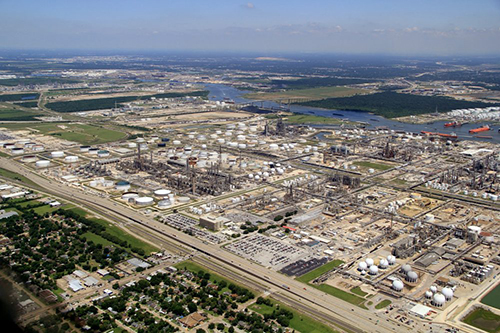
FIG. 1. Aerial view of the Trounce Deer Park Manufacturing Site in Deer Park, Texas (about 20 miles east of downtown Houston). Credit: Beat International Ltd.
Starting up
Past September xiv, 2017, most petrochemical plants along the Texas coast had restarted or initiated restart procedures (Hays, K., https://tinyurl.com/Platts-CP-Chem, 2017). Before a establish tin can be restarted, a particularly trained team must visit the site to evaluate damage and ascertain that conditions are safe for other employees to return. Restarting operations in a large facility tin can take several days, as operators comport inspections and restart equipment in phases. Rubber precautions must be followed meticulously. Shutdown and restart are the two times when refineries are most probable to explode (Wray, D., https://tinyurl.com/HP-refineries, 2017). Equally in shutdowns, backlog emissions are oft released during startups.
Restarting a petrochemical constitute requires the establishment of stable flows, levels, temperatures, and pressures inside large equipment (U.S. Chemical Safety and Hazard Inspection Board (CSB), https://tinyurl.com/CSB-alert, 2017). Sometimes, harm to equipment cannot be detected until restarting is attempted. Floodwater may have leaked into tanks, or debris could have damaged electrical motors or blocked drains. Co-ordinate to a Safety Alert issued by the CSB, petrochemical plant operators should check process equipment thoroughly for damage, including storage tanks, pressure level vessels, insulation systems, sewers and drains, furnace systems, electric motors, and emergency warning systems.
How four AOCS members weathered the tempest
In December 2017, Inform talked with four AOCS members, individual or corporate, who were affected past Hurricane Harvey (Fig. 2). Their stories illustrate how skilful training can greatly mitigate the impacts of natural disasters. Nonetheless, every storm offers the opportunity to refine emergency plans, incorporating lessons learned about which aspects of the plan worked well and which demand improvement.
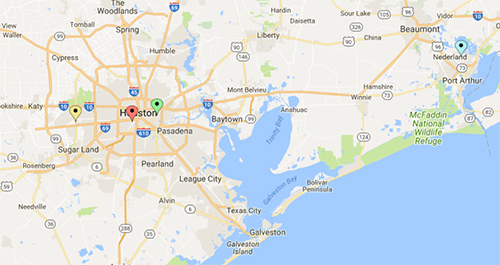
FIG. 2. Locations of four AOCS members affected by Hurricane Harvey. The hurricane fabricated landfall in Rockport, TX, and moved due east through the Houston area. Credit: Google Maps
Mark Guadagnini, General Manager, Shell Engineering science Heart, Houston, Texas
The Shell Applied science Middle is a 44-building, 200-acre free energy research complex that employs about 2,000 scientists, technologists, engineers, consultants, and sales and support personnel. The facility did not experience whatever structural impairment or flooding from Hurricane Harvey, but the heavy rain, sometimes blowing sideways, acquired leaks in roofs and walls.
As Hurricane Harvey approached, Guadagnini and colleagues implemented site contingency plans and worked closely with the laboratory community to make up one's mind which research processes must remain operational during the storm. Some of the laboratories and pilot plants were conducting experiments that had run continuously for ii years or more, so they were given priority. "We discussed which research processes needed to remain active, and how they could remain operational during the tempest," he says. "If they didn't demand to remain active, then we had to give plenty notice so they could exist close down in a controlled fashion prior to shutting down the facility." The Beat Technology Heart has its own utilities plant, and then the team calculated the scaled-downward electricity they needed to generate to run ongoing experiments and provide air conditioning and power for the skeleton crew that remained on-site.
Before Hurricane Harvey made landfall, Shell Engineering science Center employees covered valuable equipment with sheets of plastic and placed sandbags around doors in buildings that housed critical assets. They pumped water out of a decorative swimming to assistance forbid flooding. "One of the things we learned is that y'all tin can't accept enough sheets of plastic available to cover stuff," says Guadagnini. "Everybody is going to underestimate the corporeality of plastic and tape needed for an event similar this. It's well-nigh like you tin can't accept too much."
A twenty-person hurricane "live-in team" remained at the facility for v days, while other employees were sent home. Squad members had diverse backgrounds in engineering and repair. "If you remember the television show MacGyver, I was surrounded by a agglomeration of MacGyvers who knew how to fix things and brand something out of nada," says Guadagnini. "Those guys were able to make some repairs on the spot and get things started, and that enabled us to be back up and operational merely four days afterwards the hurricane."
After the storm, the Shell Technology Center brought the experiments and chemical processes back to full operations in a disciplined, controlled fashion. "Although we could chop-chop bring equipment and utilities back online, we didn't have the people in place to outset everything back up until the roads cleared and dried out," says Guadagnini. Due to transportation bug, the facility too had problems obtaining chemicals, equipment, and spare parts for at least 10 days afterwards the tempest. "So that besides went into the calculus of what to bring dorsum to operational status and what to exit close down—our ability to get logistically resupplied," he says.
Guadagnini credits communication, preparation, and practice for the success of the Shell Engineering science Center in weathering Hurricane Harvey. "Nosotros worked very hard at the outset of the year on revitalizing our hurricane preparedness plan, and we took many opportunities to communicate with our employees nigh the plan," says Guadagnini. Employees practiced the emergency preparedness plan through a series of table-top drills, where a particular disaster scenario was presented, and employees had to respond to it using the program. The center equally a whole was then debriefed on lessons learned from the practice. "My best communication is to take the opportunity to railroad train to your programme," says Guadagnini. "If you don't do something, you're going to be terrible at it. Conversely, if y'all practice your plan, then you will do well in execution."
Robert Poullard, Laboratory Manager, Jacob Stern & Sons, Houston, Texas
Jacob Stern & Sons is a company that imports, exports, processes, and distributes animal fats and oils. At their facility in Houston, the visitor has more than forty storage tanks containing different grades of tallow that are used in soaps, personal care products, and cosmetics. Jacob Stern & Sons is located along the Houston Ship Channel, giving the exporter access to bounding main-going vessels. During Hurricane Harvey, the facility experienced some flooding and roof leaks but suffered no substantial damage. "The part buildings had the most damage," says Poullard. "Nosotros still have big holes in the ceilings, and the roof still needs to be repaired, but the found is working at almost 100% chapters."
Jacob Stern & Sons only had to shut downwardly completely for virtually half of a week. However, the company, similar others in the area, experienced transportation issues for much longer. "Most of our products are delivered to united states of america past trucks and by rail cars, but they couldn't get to u.s.a. for a week to two weeks," says Poullard. "Our business concern consists of exporting, and we just couldn't get any ships here when the time called." He also says that the company experienced some brief power outages.
Some docks forth the Houston Ship Channel were flooded by the waterway. Yet, Jacob Stern & Sons was not affected substantially because high levees were built around storage tanks to protect them from flooding. In the days before the storm, employees boarded up windows. "This isn't our showtime rodeo, so we knew what was coming and prepared ahead of time," says Poullard. "But Harvey wasn't so much a wind issue; it was generally rain."
Later streets and highways flooded, some employees were stranded at the Jacob Stern & Sons plant for more than than 48 hours. Poullard couldn't become back to the plant because the streets surrounding his neighborhood were flooded. "Interstate x is ane of the main freeways that runs through the city, and we couldn't go to it considering it was flooded," says Poullard. "The freeway exits around here had over 10 feet of water, so fifty-fifty if you could get on the freeway, you couldn't get off information technology." Some employees voluntarily stayed at the facility to continue an center on things. "A lot of guys who take been here for 30 or xl years wanted to stay to help out in case something went wrong," says Poullard. "We've got a lot of good guys here who take been through this before and don't heed merely hanging around and making sure the constitute is okay."
Because Jacob Stern & Sons is located along the Houston Ship Channel, a possible target for terrorists, the company plans ahead for both natural and manmade disasters. "Nosotros set for whatever kind of disaster, because you merely never know," says Poullard. "We practise that, we preach that, and we coordinate with the Coast Guard."
William Wilson, Lab Managing director, Department of Chemistry, Rice Academy, Houston, Texas
Rice University is a private research university located in central Houston. The 295-acre wooded campus is adjacent to the Texas Medical Eye. Due largely to improvements made since Tropical Storm Allison in 2001, Rice University suffered minimal damage from Hurricane Harvey. Several buildings had pocket-size impairment due to leaks, and at to the lowest degree three basements flooded. Many of Rice's most iv,000 undergraduate students remained on campus in their dormitories during the storm. The academy was closed for 10 days because of the hurricane, reopening on September v.
Considering the roads on and around Rice University were flooded, students and employees who lived off campus were advised not to effort to reach the university. Notwithstanding, Wilson, who manages the lab of Professor Seiichi Matsuda, managed to make information technology to work every day. "Most people could non drive to work because freeways and major roads were impassable at certain places," says Wilson. "Yet I could get about anywhere on my bicycle within a 7-mile radius of Rice University, day or dark—except on Sunday, when I had to cross on the railroad trestle."
On Sunday, August 27, the worst twenty-four hour period of flooding, Wilson started bicycling toward Rice. Although bayou bridges were flooded with raging water, he walked safely across on a railroad trestle, with a "dazzling yet terrifying view of lakes everywhere." The final 3 miles involved wading through ankle-deep to waist-deep water. "Running through floodwater is dangerous considering it is easy to stumble over a curb," says Wilson. Wading through floodwaters is also not brash due to risks from burn ants, bacteria, displaced manhole covers, and drowning. Dangerous snakes often seek the higher ground of railroad tracks during floods.
Nevertheless, Wilson fabricated it to the lab building, which he says was "about deserted." The building did not experience whatsoever power outages considering of the storm, and then Wilson attempted to spend $4,000 in remaining inquiry grant money that expired on August 31. "I tried to persuade vendors to bill our credit bill of fare and send an invoice, merely delay shipment for a week," says Wilson. "Instead, the opposite happened. One company immediately sent u.s.a. biological supplies requiring -twenty ºC refrigeration, and they arrived after 10 days at room temperature." Because of storm-related difficulties, Wilson was only able to spend about half of the expiring grant money.
In preparation for Harvey, Wilson shut down the lab's mass spectrometers and other expensive equipment, and readied 20-amp extension cords to plug the -80 ºC freezers into emergency power sources, if needed. Because the lab was located on the third flooring of the edifice, flooding was non a concern. "Unlike preparation for rain coming in broken windows from the vehement winds of Hurricane Ike in 2008, I was not worried well-nigh broken windows from Harvey," says Wilson. According to Wilson, the nearby Texas Medical Center (TMC) took serious precautions to protect confronting flooding after beingness devastated by Tropical Storm Allison in 2001. "TMC'south actions inadvertently helped protect Rice and the University of Houston from flooding," he says. TMC'south measures included new flood-resistant buildings, floodgates, and elevated power supplies. In addition, Brays Bayou, which runs direct through the TMC and is adjacent to the University of Houston, was widened from the TMC to several miles downstream after it caused massive flooding during Allison.
Republic of chad Anderson, Site Director, Port Neches Operations, Huntsman Port Neches, Texas
Huntsman'south Port Neches Operations facility makes propylene and ethylene, converts them to propylene oxide and ethylene oxide, and and then derivatizes the oxides to generate surfactants, amines, and glycols. With three ethylene oxide units, the Huntsman Port Neches plant is the largest single-site producer of ethylene oxide in North America.
During Hurricane Harvey, Huntsman shut downwardly six manufacturing sites, including Port Neches, as well as the globe headquarters building and the Advanced Applied science Center located in The Woodlands, Texas. According to Anderson, Port Neches Operations experienced flooding, but no major structural damage. The Port Neches facility had several flooded buildings, more often than not in maintenance areas. Floodwaters entered some electric motors, requiring the motors to exist removed from equipment and dried. "For the most function, the damage was quite minimal to our facilities," he says. "The primary effect that nosotros had was the result on the surrounding customs, which prevented employees from coming to work and prevented deliveries and shipments to and from the facility. And, of course, nosotros were restricted with power and things of that nature from time to fourth dimension as a event of the hurricane."
Anderson and coworkers brought the Port Neches facility to an idle four days before the hurricane struck the Houston area. "Nosotros were having bug getting trucks into and out of the facility several days in advance of the storm, so we shut the facility down," says Anderson. "Nosotros did go out our utilities department of the institute running so as not to permit the steam lines and things of that nature to get cold during the event."
For about ii.5 weeks, a ride-out coiffure remained at Port Neches, maintaining the facility and operating the cogeneration units that produced electricity. Port Neches' first ethylene oxide unit went back online on September 4, and the site had returned to pre-Harvey operating conditions by September sixteen. Harvey'southward impact on Huntsman'southward tertiary quarter net earnings for all sites was estimated to exist $l one thousand thousand.
Port Neches Operations was affected previously by Hurricanes Rita and Ike. "With Hurricane Rita in 2005, we learned a great deal about setting upward timeframes to showtime idling production and making decisions about whether to continue the plant running or shut it downwardly," says Anderson. "We farther refined that procedure during Hurricane Ike." Now, Huntsman has an emergency procedure that varies slightly with the location, intensity, and hazards of the storm. With regard to hazards, Hurricane Rita was mainly a wind upshot at Port Neches, whereas Ike was a tempest surge event. "Harvey had some current of air but no storm surge. Information technology was mostly a pelting result, and so it tested our procedure over again," says Anderson. "But whenever you start losing your ability to move raw materials into and products out of the facility, information technology pushes yous downwardly your timeline of bringing the plant to an idle state and sending your nonessential people home."
Post-obit Hurricanes Rita and Ike, Huntsman besides inverse some of their building practices within the Port Neches facility. "All of our new construction is about 8 feet off the footing to protect from a potential storm surge or flooding event," says Anderson. "Nosotros've also started raising disquisitional instrumentation and electrical infrastructure up to a sure level." He notes that Jefferson Canton, where Port Neches is located, has a 13-pes (4-thou) retaining wall that protects the area from pregnant storm surges. Anderson has some advice for other companies preparing for natural disasters. "Don't ever say, 'This volition never happen here,'" says Anderson. "Nosotros never expected to run into 5 feet of rain in a 5-day menses, but information technology happened. As you lot go through your procedure reviews and preparations for inclement weather, the impossible can be quite possible, so prepare for the impossible."
He as well has some communication near making the determination to close down a facility or continue it operating. "Don't recall about what you can make during the storm; think about how rapidly you can recover at the end of it," says Anderson. "Nosotros run highly chancy processes, so we're going to close the processes down, allow the upshot to laissez passer, and then nosotros should be in much better shape to outset things up and get more quickly back to normal operations." Anderson says that the Huntsman leadership fully supported the decision to shut down operations. "The merely pressure we got from the company was to do it safely, and exercise it compliantly," says Anderson. "It's very nice to have that support from the CEO down to protect your people, protect the environment, and protect your assets."
During the tempest, Anderson was inspired to see Huntsman employees helping each other and the community. "We had an employee who was actually trapped in his attic by floodwaters. His firm had 8 feet of water in it," says Anderson. "We had three employees go dwelling, get their boats, and rescue him and his family unit out of his house. Then they moved on to other houses in the neighborhood." Later on the storm concluded, teams of Huntsman employees helped clean up other employees' homes that were damaged by the hurricane. Jon Huntsman, Sr., founder of the company and Chairman Emeritus, donated $ii 1000000 to constitute the Huntsman Overflowing Fund to help the community recover.
Anderson estimates that about 250 of the 620 Huntsman employees at the Port Neches site sustained damage to their homes from the storm. "We've got people who come up to work and exercise their normal job from 8 a.one thousand. to v p.grand., or whatever their shift might be, and and so they're going abode and trying to rebuild," he says. "The expanse's back to normal past no stretch of the imagination, simply the found's dorsum to normal and running smoothly. People are just trying to rebuild their lives outside of the facility."
Laura Cassiday is an associate editor of Inform at AOCS. She can be contacted at laura.cassiday@aocs.org.
Information
- American Chemical science Quango (2017). "Chemic industry prepared for new tempest heading to U. South. gulf coast." American Chemical science Council web log mail, August 24, 2017.
- American Chemistry Council (2017) "Statement by ACC President and CEO Cal Dooley in response to Hurricane Harvey." Press release, August 31, 2017.
- Bomgardner, Thou. K. (2017) "After Harvey, Texas faces massive cleanup." Chemical & Applied science News 95, 4–5, September 4, 2017.
- U. S. Chemical Safety and Hazard Investigation Board. (2017) "Afterward Harvey: precautions needed during oil and chemical facility startup." CSB Safety Alert, August 28, 2017.
- Griggs, T, et al. (2017) "More than than forty sites released chancy pollutants because of Hurricane Harvey." The New York Times, September eight, 2017.
- Hays, K. (2017) "CP Chem post-Harvey inspections continue, no timeline for restart." S&P Global Platts, September 14, 2017.
- Kaskey, J. (2017) "Harvey disrupts more than than a 3rd of US chemic production." Bloomberg, August 28, 2017.
- Kaskey, J. (2017) "Harvey has fabricated the globe's most important chemical a rare commodity." Bloomberg, August 31, 2017.
- Williams, S., and Grant, B. (2017) "Labs in Texas batten down the hatches." The Scientist, August 25, 2017.
- Wray, D. (2017) "Hurricane Harvey volition hitting the Texas oil industry no matter where information technology lands." Houston Press, Baronial 25, 2017.
Source: https://www.aocs.org/stay-informed/inform-magazine/featured-articles/lessons-learned-from-hurricane-harvey-march-2018?SSO=True
0 Response to "When Wil Pst Office Start Again After Hurricane Harvey"
Post a Comment